
WordPress website redesign case study. Problem: El Rincón Tours & Transportation, a Costa Rica tour operator, sells tours, park tickets and transport through a WooCommerce booking site that ranked well but scored 64 on mobile PageSpeed, ran 50+ plugins and looked inconsistent. What we did: redesigned the key pages with one design system, removed 19 unused or duplicate plugins, slimmed CSS and page data, fixed accessibility, and verified SEO parity on all 68 indexable URLs after every change, staging first. Result: mobile PageSpeed 64 → 94, with Accessibility, Best Practices and SEO at 100, bookings uninterrupted, and no titles, URLs or schema lost. Stack: WordPress, WooCommerce, Elementor Pro, Astra Pro, LiteSpeed Cache, Rank Math.
- Client
- El Rincón Tours & Transportation (rincondelaviejapark.com)
- Industry
- Tourism, park tickets and transport
- Location
- Guanacaste, Costa Rica
- Services
- WordPress development, WooCommerce, redesign, speed and accessibility
- Stack
- WordPress, WooCommerce, Elementor Pro, Astra Pro, LiteSpeed Cache, Rank Math, Code Snippets
- Delivered by
- PlusTechnology
The challenge
El Rincón sells tours, national park tickets, transport and combos through WooCommerce, with a date-and-time booking calendar. The website is the booking engine, and over the years it had grown heavy:
- Slow on mobile. PageSpeed scored 64 on mobile, with a Largest Contentful Paint of 6.4 s, and field data from real visitors was failing Core Web Vitals on LCP.
- Plugin bloat. More than 50 plugins were active, many unused or doing the same job twice: page builder add-on packs, popup builders, sliders, file managers and a second booking system.
- Inconsistent design. Pages built at different times used different fonts, colours and layouts, and the tour product pages looked dated.
- Strong SEO to protect. The site ranks well for its niche, so every title, URL, heading, schema block and video rich result had to survive untouched.
The brief: make it fast, modern and consistent, without changing the content, breaking bookings or affecting SEO.
How we ran a WordPress website redesign on a live booking site
The site takes real bookings every day, so the process mattered as much as the design:
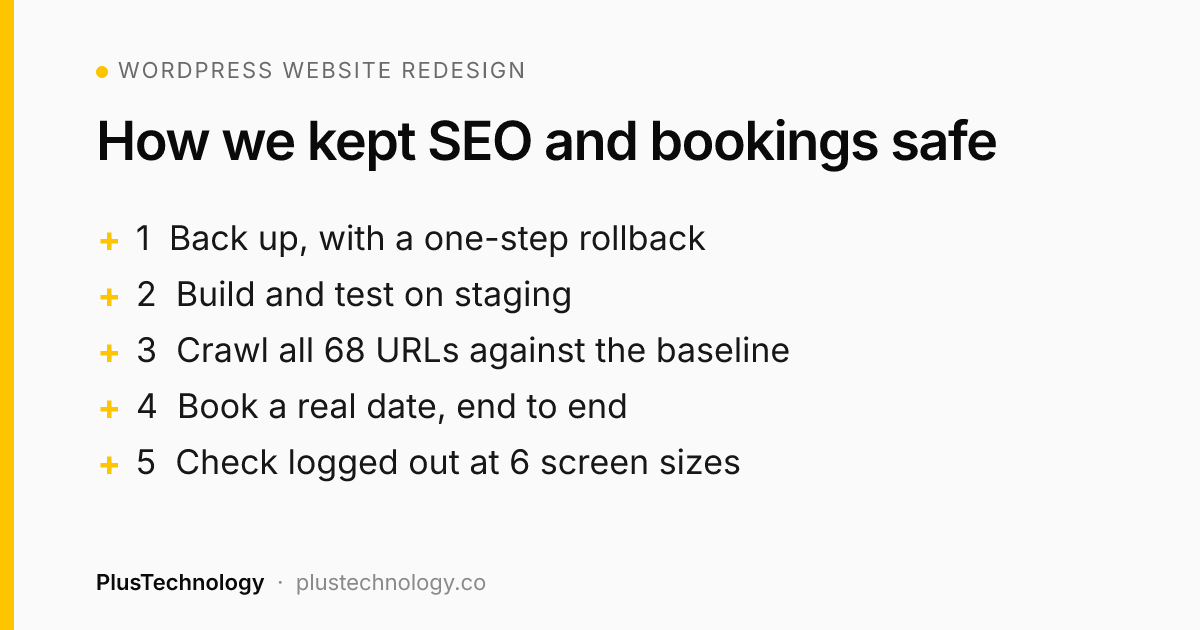
- Back up before every change. Every page, template and setting was exported before it was touched, alongside the host's daily backups, and every change had a documented one-step rollback.
- Staging first. Each redesign was built and tested on a staging copy and applied to live only after approval.
- Prove SEO parity, don't assume it. After each step we crawled all 68 indexable URLs and compared them with the pre-change baseline: titles, meta descriptions, canonicals, robots tags, H1 and H2 structure, schema (including VideoObject), links, images and visible text.
- Test the booking flow end to end. After each group of changes we booked a real date and time, checked cart, checkout, payment gateways, the required policy checkbox and totals, then removed the test item.
- Check as a real visitor. The cache serves logged-out visitors different HTML, so every check ran logged out at 360, 390, 768, 1024, 1366 and 1440 px.
- Keep a written change log, so the client's team always knows what changed and how to undo it.
We cover the same method in how to redesign a website without losing SEO. All scores on this page are from Google PageSpeed Insights.
Speed and plugin cleanup
- 19 unused or duplicate plugins removed, including two page builder add-on packs, a popup builder, a slider, the unused second booking system, file managers and old migration tools. Before switching each one off, we scanned every live page to confirm it wasn't in use.
- Lightweight code instead of plugins where it made sense. A small custom tour card shortcode replaced a heavy add-on widget, and XML-RPC protection moved into a short code snippet.
- Leaner CSS delivery. Elementor CSS now loads as cached files instead of inline, fonts use
font-display: swap, and legacy icon libraries are off. - Homepage: the hero image is preloaded, and the booking calendar libraries no longer load on pages that don't use them. Homepage HTML went from 434 KB to 348 KB.
- Lighter page data. The Videos page went from 331 KB of builder data to 11 KB, with the same videos, text and links.
A design system across the key pages
We built one visual language, with the brand green and navy, a modern heading typeface and SVG icons instead of emoji, and applied it to the homepage, Our Services, About, Reviews, Blog, Contact, Cart and Checkout, keeping the same copy and SEO tags.
- Tour product template: a cleaner gallery, a price and booking card with a high-contrast calendar, and a mobile Book Now bar. Each tour's own description design stayed as the client's editor built it.
- Videos page: each video became a card with its Book your activity button. The video rich results were preserved, and the players still lazy-load.
- Cancellation policy: restyled with section icons, clear headings and one-tap contact buttons using CSS only. The policy text is byte-for-byte unchanged.
Accessibility to 100
We fixed colour contrast on the booking calendar and buttons to WCAG AA, added accessible titles to embedded maps, and corrected pages with duplicate or missing H1s. Accessibility went from 89 to 100.
Support after launch
Videos and maps disappearing from tour pages
After launch, the client reported that YouTube videos and Google Maps kept vanishing from tour pages. The cause: WordPress strips embed code when content is saved by a user role without full HTML permission, so every time the shop manager updated a tour, its embeds were removed. It had happened before, months earlier.
We rebuilt the original embed code from saved copies of the pages and restored 43 videos and maps across 16 tours, each in its exact position. Then, instead of giving the account full HTML rights, we added a small safeguard that allows only YouTube and Google Maps embeds when non-admins save. Scripts and unknown iframes are still blocked. A simulated save on every product confirmed all embeds and content survived.
Matching the original tour descriptions exactly
When the content editor noticed the new template had changed some description layouts, we measured the old and new designs element by element and adjusted the template until they matched: 0 differences across 410 elements at four screen sizes. The rest of the redesign stayed in place.
Results
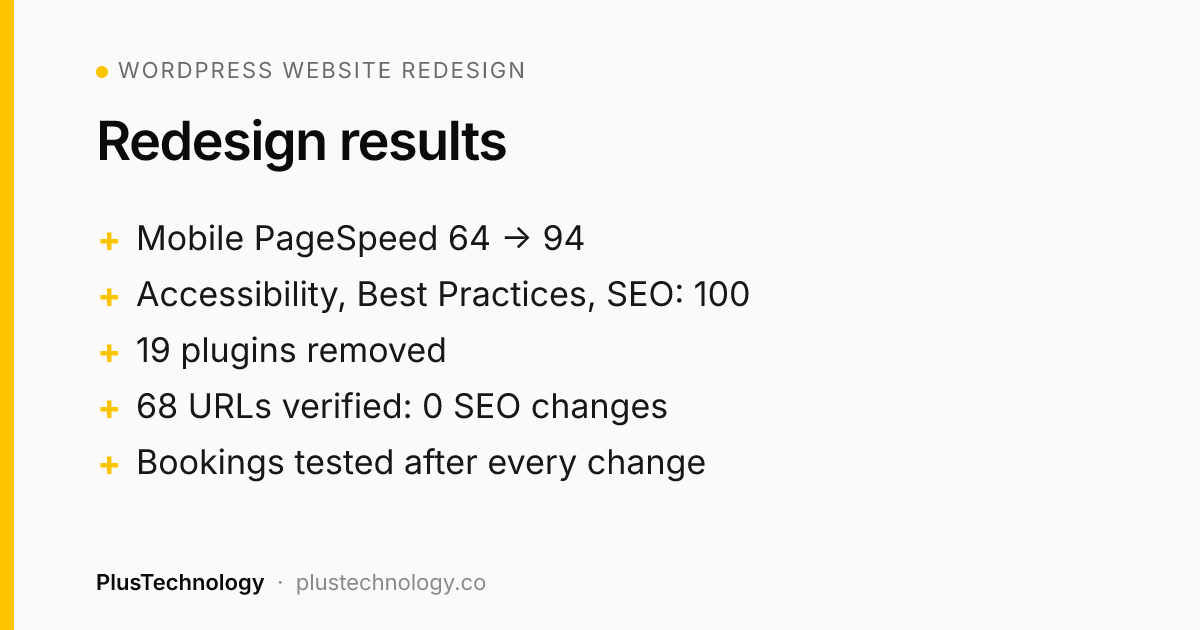
- Mobile PageSpeed Performance from 64 to 94, with Accessibility 100 (from 89), Best Practices 100 and SEO 100 (from 92).
- SEO preserved: every title, description, canonical, robots tag, heading, schema block and video rich result verified identical across all 68 indexable URLs after each change.
- Bookings uninterrupted: the full booking and checkout flow was tested after every change and kept working throughout.
- A leaner site: 19 fewer plugins and lighter pages, with less to update and secure.
- Fully documented: a change log with backups and a one-step rollback for every change.
We also built El Rincón's custom tour booking system and the digital waiver system used at La Leona Waterfall.
Tech stack
| Area | Technology |
|---|---|
| Site and store | WordPress, WooCommerce, Elementor Pro, Astra Pro |
| Speed | LiteSpeed Cache, Elementor file-based CSS, custom shortcode and snippets |
| SEO | Rank Math, with custom crawls comparing all 68 indexable URLs against a baseline |
| Testing | Google PageSpeed Insights and Lighthouse, end-to-end booking tests, custom PHP, CSS and Python tooling for backups and parity checks |
WordPress website redesign FAQ
Can you redesign a WordPress website without losing SEO?
Yes, if you prove it rather than assume it. On El Rincón we crawled all 68 indexable URLs after every change and compared titles, meta descriptions, canonicals, robots tags, headings, schema, links, images and visible text against the original. Nothing changed that we didn't intend.
How do you redesign a site that takes bookings every day?
Staging first, a backup and one-step rollback for every change, and a real end-to-end booking test after each group of changes: date and time, cart, checkout, payment gateways and totals. Bookings kept working throughout.
Why do YouTube videos disappear from WordPress pages?
WordPress strips embed code when content is saved by a user role without full HTML permission. We restored 43 videos and maps across 16 tours and added a safeguard that allows only YouTube and Google Maps embeds for non-admins, so scripts and unknown iframes stay blocked.
How many plugins should a WordPress site have?
There is no fixed number, but every plugin adds code to load, update and secure. On this site we removed 19 that were unused or duplicated, after scanning every live page to confirm they weren't in use.
Related reading
Want something similar for your business? Hire PlusTechnology on Upwork or get in touch.