
AI search optimization means making your website easy for ChatGPT, Claude, Perplexity and Google's AI Overviews to find, understand and quote. In practice: let AI crawlers in, get indexed in Google and Bing, write answer-first pages with question-style headings, add schema markup, keep your business facts identical everywhere, publish real numbers others can cite, and measure AI referrals. Nobody can guarantee a mention, but these steps make you much easier to recommend.
More and more buyers skip the list of blue links and ask an assistant instead: "Who can build a WooCommerce store for my business?" or "What does a small business website cost?". If the assistant doesn't know your business, you're not in the answer. This guide explains what AI search optimization is, how the assistants pick their sources, and the seven steps we use on client sites and on plustechnology.co itself.
What is AI search optimization?
AI search optimization, also called generative engine optimization (GEO), is the work of making your content easy for AI assistants to discover, understand and cite. Traditional SEO aims for a high position on a results page. AI search optimization aims for something slightly different: being one of the few sources an assistant reads, trusts and mentions by name when it writes its answer.
The good news: it isn't a separate discipline you have to start from scratch. Most of it is solid technical SEO plus content written so that a machine can lift a clear answer out of it.
How do ChatGPT, Claude and Google's AI choose their sources?
When an assistant searches the web, it doesn't read the whole internet. It runs searches, fetches a handful of pages, and writes an answer from them. The main paths are:
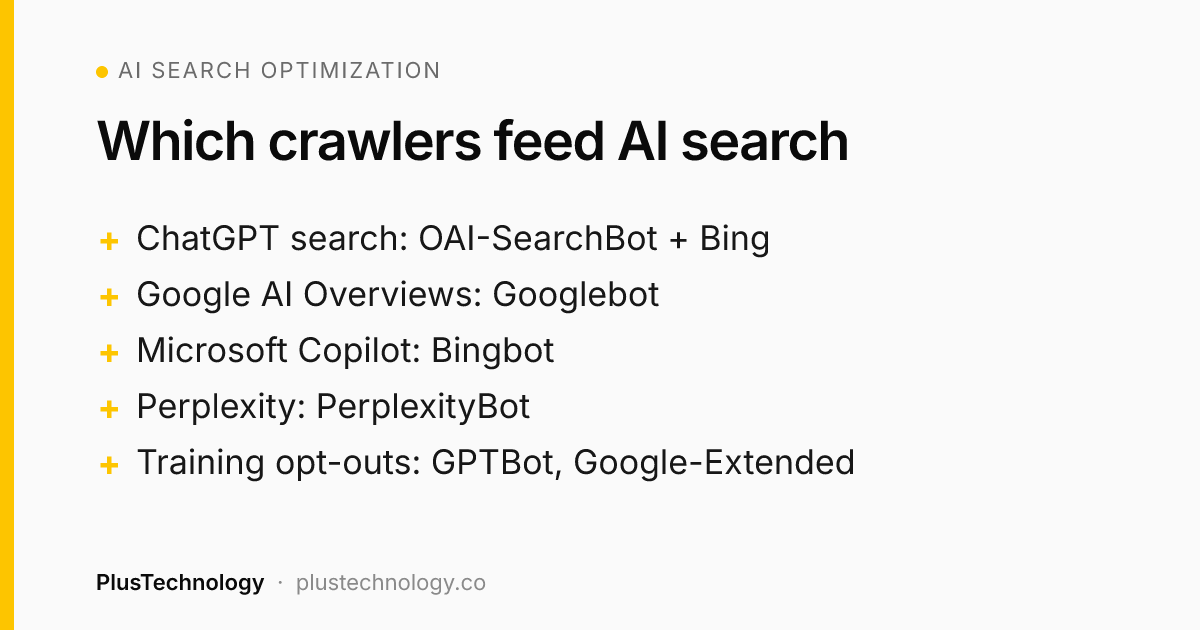
- ChatGPT search uses OpenAI's search crawler,
OAI-SearchBot, together with results from search partners such as Bing. - Google AI Overviews and AI Mode are built on Google's normal search index, so ordinary Google indexing is the entry ticket.
- Microsoft Copilot answers from Bing's index.
- Perplexity runs its own crawler,
PerplexityBot, plus web search. - Claude can search the web when web search is enabled, and Anthropic runs its own crawlers for search and training.
Two things follow from this. First, if search engines can't index a page, assistants usually can't use it either. Second, assistants prefer pages that answer the exact question in a few clear sentences, because that's what they need to build a reply.
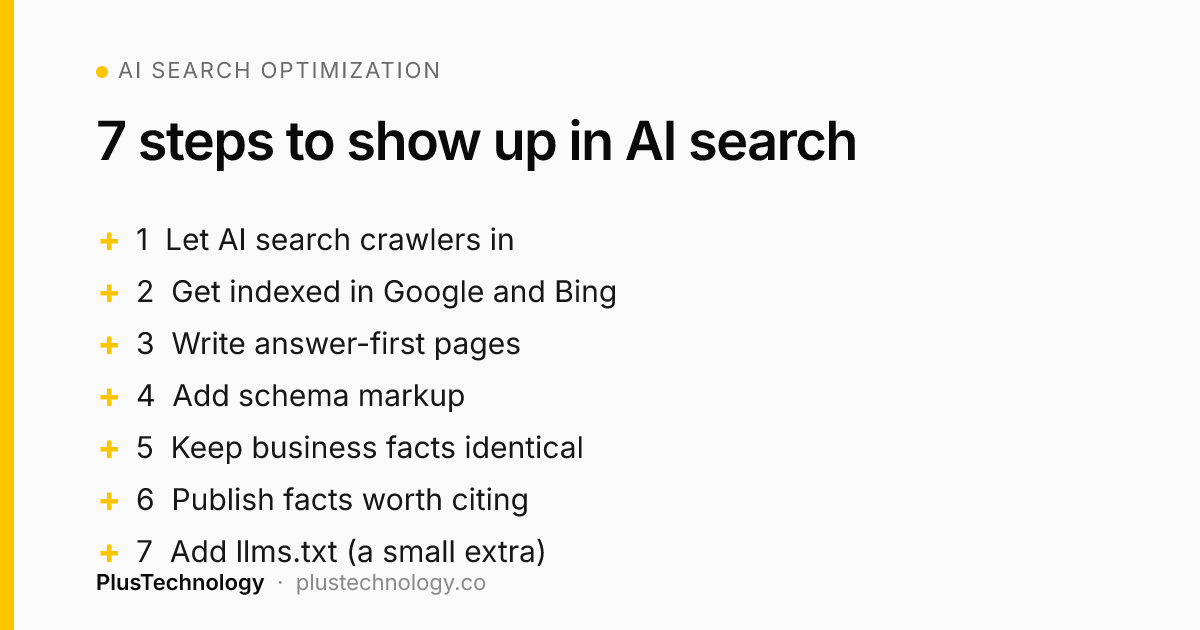
7 steps to show up in ChatGPT and AI search
1. Let the AI crawlers in
Check your robots.txt and your firewall or CDN bot settings. Some security plugins and "block AI bots" toggles stop search crawlers as well as training crawlers. If you want to appear in AI answers, don't block OAI-SearchBot, PerplexityBot, Bingbot or Googlebot. You can still opt out of model training separately (for example with GPTBot or Google-Extended) without disappearing from search. OpenAI explains the difference in its crawler documentation.
2. Get indexed in Google and Bing
Verify your site in Google Search Console and submit your XML sitemap. Then do the step most businesses skip: add the site to Bing Webmaster Tools (you can import it from Search Console in a minute) and turn on IndexNow if your SEO plugin supports it. Because ChatGPT and Copilot lean on Bing, a site that is missing from Bing is often missing from their answers too.
3. Write answer-first pages
Start each important page with a two- or three-sentence answer to the main question, then explain the details. Use question-style headings ("How much does a business website cost?") that match how people talk to assistants. Short paragraphs, lists and simple tables are easy for a model to quote accurately. Every guide on this blog opens with a "Quick answer" box for exactly this reason.
4. Add schema markup
Structured data tells machines what a page is about without guessing. For a service business the essentials are Organization (name, logo, description, social profiles), Service for each service page, FAQPage for real FAQs, Article or BlogPosting for guides, and BreadcrumbList. Keep the facts in your schema identical to what the page says. Mismatches undermine trust.
5. Keep your business facts identical everywhere
Assistants build their picture of your company from many sources: your website, LinkedIn, Upwork, Google Business Profile, directories such as Clutch, and articles that mention you. Use the same company name, one-sentence description, services and website link on all of them. If your site says "web development company" and LinkedIn says "graphic design agency", the assistant has to guess, and it usually guesses vaguely or not at all.
6. Publish facts that are worth citing
Assistants like specific, checkable information: price ranges, timelines, comparisons and results with numbers. Case studies with real figures, honest cost guides and clear "what's included" lists give an assistant something concrete to quote. Generic marketing copy ("we deliver excellence") gives it nothing. Never invent numbers; publish only what you can back up.
7. Add an llms.txt file (a small extra)
llms.txt is a proposed standard: a plain-text file at the root of your site that summarises who you are and links to your key pages. It takes an hour to write and some AI tools read it, but none of the big AI search engines has confirmed it affects rankings. Do it after steps 1–6, not instead of them. You can see ours at plustechnology.co/llms.txt.
SEO vs AI search optimization: what's different?
| Traditional SEO | AI search optimization | |
|---|---|---|
| Goal | Rank high on a results page | Be read and cited inside an AI answer |
| Foundation | Crawling, indexing, speed | The same, plus access for AI search crawlers |
| Content style | Comprehensive pages for a keyword | Direct answers first, then depth |
| Trust signals | Backlinks | Backlinks plus consistent mentions across many sites |
| Structured data | Helpful for rich results | Important for understanding entities |
| Measurement | Rankings, clicks, impressions | AI referral traffic and manual answer checks |
If you already invest in SEO, you're most of the way there. If you're planning a new site or a redesign, build these steps in from day one; it's far cheaper than fixing them later. Our guide to redesigning a website without losing SEO covers the technical side.
How to measure AI search visibility
- Referral traffic: in Google Analytics 4, look for sessions from
chatgpt.com,perplexity.ai,copilot.microsoft.comandgemini.google.com. ChatGPT also tags many links withutm_source=chatgpt.com. - Manual checks: once a month, ask the assistants the questions your customers ask ("best WooCommerce developer for a small store", "who builds booking systems for tour companies") and note whether you're mentioned and which page is cited.
- Search Console and Bing Webmaster Tools: AI Overviews traffic is counted inside normal Google Search data, and Bing shows how often your pages are crawled and indexed.
Common AI search optimization mistakes
- Blocking every AI bot by default with a security plugin, then wondering why ChatGPT never mentions you.
- Ignoring Bing because "nobody uses Bing". Several assistants do.
- Hiding answers behind long intros, sliders, tabs that need clicks, or images of text.
- Inconsistent company details across your website and profiles.
- Buying "AI ranking" guarantees. No one controls what an assistant says. Be wary of anyone who promises a guaranteed mention.
Frequently asked questions
What is AI search optimization?
AI search optimization (also called generative engine optimization, or GEO) is the work of making your website easy for AI assistants such as ChatGPT, Claude, Perplexity and Google's AI Overviews to find, understand and quote. It builds on normal SEO: crawlable pages, clear answers, structured data and consistent facts about your business across the web.
How do I get my business to show up in ChatGPT?
Make sure your site is indexed by Google and Bing and that ChatGPT's search crawler (OAI-SearchBot) is not blocked in robots.txt. Then publish clear, answer-first pages about your services and prices, add schema markup, and keep your business name, description and links identical on your website, LinkedIn, Upwork and directory profiles.
Is AI search optimization different from SEO?
It overlaps heavily. AI assistants mostly rely on search indexes and crawlers, so technical SEO is still the foundation. The difference is emphasis: AI search rewards short, direct answers, question-style headings, facts that are easy to quote and a consistent description of your business across many sites.
Does llms.txt help with AI search?
llms.txt is a proposed standard for giving AI tools a plain-text summary of your site. It is cheap to add and helps some AI tools, but none of the major AI search engines has confirmed that it affects rankings. Treat it as a small extra, not a replacement for the other steps.
How long does AI search optimization take to work?
Once Google and Bing re-crawl your pages, changes can appear in AI answers within a few weeks, but there is no fixed timeline and no guarantee of being cited. Building trusted mentions on other sites takes longer.
Want your website ready for Google and AI search? PlusTechnology builds every site with technical SEO, schema and answer-first content. See our web development services or send us a message on Upwork.