

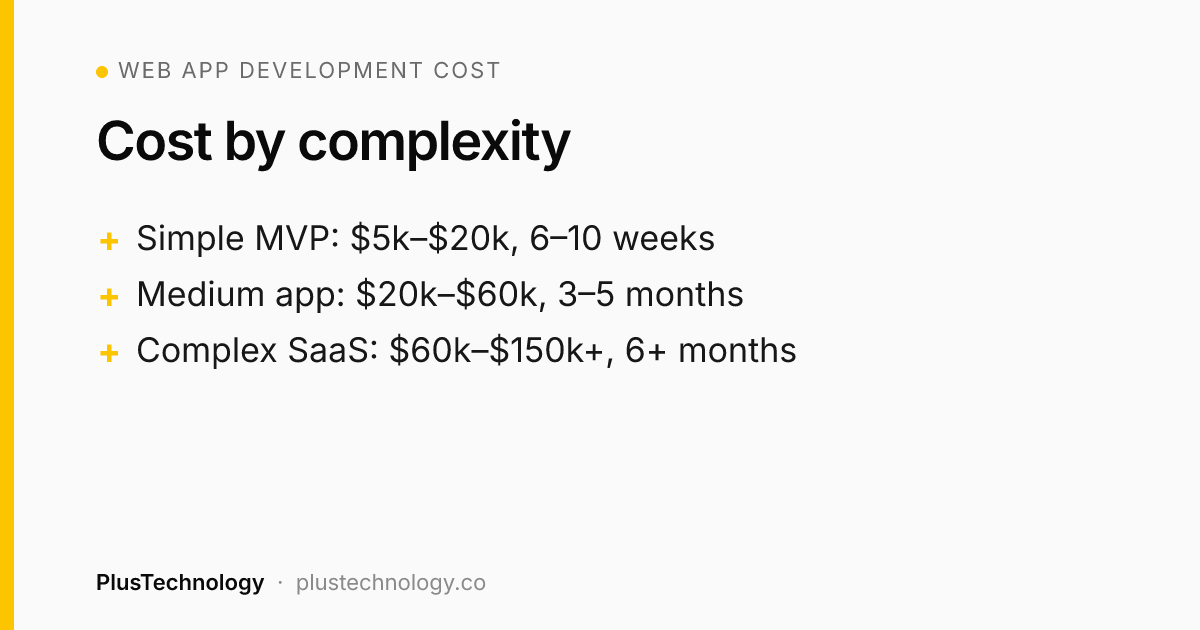
Web app development cost depends mostly on complexity. With an experienced freelancer, a simple web app or MVP costs about $5,000–$20,000 and takes 6–10 weeks. A medium-complexity app (multiple user roles, payments, integrations, dashboards) costs $20,000–$60,000 over 3–5 months. A complex SaaS platform costs $60,000–$150,000+. Agencies typically charge 2–3× freelancer rates. Budget another 15–20% of the build cost per year for hosting, maintenance and improvements.
"How much will my app cost?" is the first question almost every client asks me, and the honest answer is "it depends on what it has to do." So instead of a single number, here are the ranges I see in practice and the factors that move a project from one range to the next.
Web app development cost by complexity
| Type | Examples | Typical cost (freelancer) | Timeline |
|---|---|---|---|
| Simple / MVP | Booking tool, internal dashboard, quote calculator, simple directory | $5,000–$20,000 | 6–10 weeks |
| Medium | Client portal, marketplace MVP, multi-role SaaS, LMS | $20,000–$60,000 | 3–5 months |
| Complex | Full SaaS with billing, real-time features, analytics, mobile apps | $60,000–$150,000+ | 6+ months |
These are typical ranges for experienced freelancers and small teams working remotely. US or UK agencies often quote two to three times more for the same scope.
What drives web app development cost?
Price comes down to how many hours the app takes to design, build and test. These are the factors that add the most hours:
- Number of user roles. Each role (customer, staff, admin, partner) needs its own screens and permissions.
- Payments and subscriptions. Stripe makes this easier, but plans, trials, invoices and failed payments all need handling.
- Integrations. Every external system (CRM, accounting, calendars, shipping, AI APIs) adds build and testing time.
- Real-time features. Chat, live updates and notifications are more complex than standard pages.
- Custom design. A fully custom UI costs more than a polished component library.
- Data and reporting. Dashboards, exports and analytics take more effort than people expect.
- Security and compliance. Handling health, financial or children's data (HIPAA, GDPR, PCI) adds requirements.
Freelancer vs agency vs in-house: who should build it?
| Freelancer | Agency | In-house team | |
|---|---|---|---|
| Typical rate | $30–$100/hour | $80–$200+/hour | Full-time salaries plus overhead |
| Best for | MVPs, small to medium apps | Large, multi-discipline projects | Long-term core products |
| Communication | Directly with the developer | Through a project manager | Internal |
| Risk | Depends on one person | Higher cost | Hiring time and fixed cost |
For a first version, an experienced full-stack freelancer is often the best value. You get direct communication and lower cost, and you can grow the team once the product proves itself.
Ongoing costs people forget
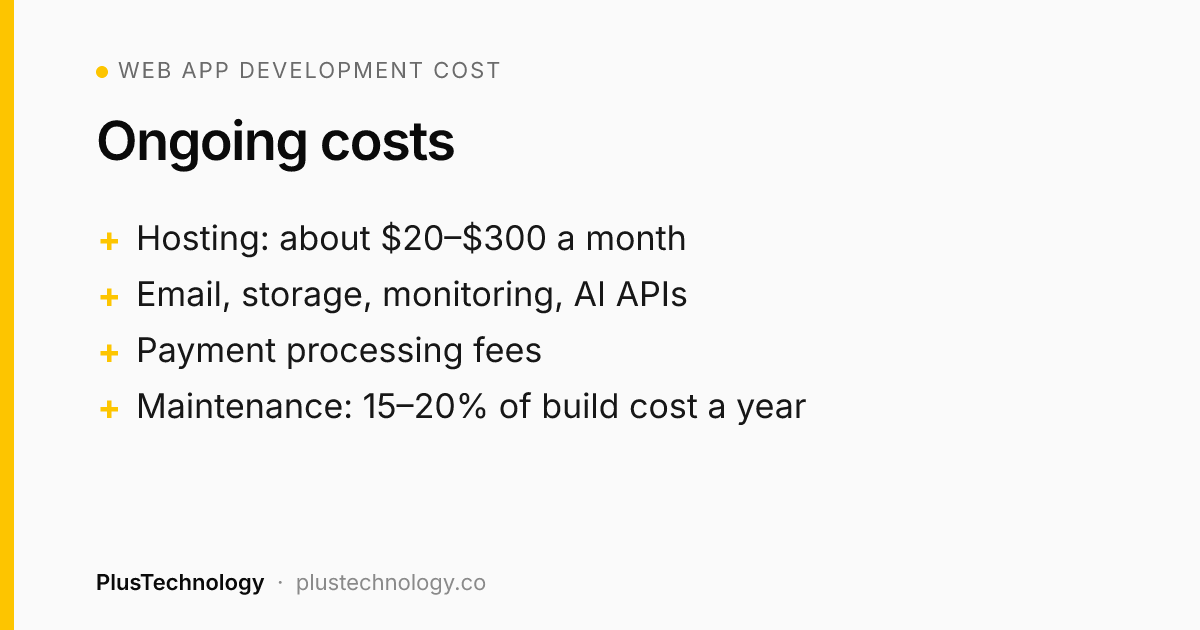
- Hosting and database: often $20–$300 per month early on (Vercel, Render, AWS, Supabase, managed PostgreSQL).
- Third-party services: transactional email, file storage, error monitoring, maps, SMS and AI APIs.
- Payment processing: card fees on every transaction.
- Maintenance: security updates, dependency upgrades and bug fixes. A common rule of thumb is 15–20% of the build cost per year.
- New features: once real users arrive, they'll ask for things. Budget for them.
How to keep your MVP affordable
- Build the one workflow that matters. Write down the single job your app must do for the user, and build only that for version one.
- Use proven building blocks. Authentication (Supabase, Clerk, Auth.js), payments (Stripe) and email (Postmark, Resend) are solved problems. Don't build them from scratch.
- Start with a component library. A clean UI kit is much cheaper than fully custom design, and you can refine the look later.
- Consider WordPress as a backend for content-heavy apps, membership sites or directories. It can save weeks.
- Automate before you build. Some "apps" are really workflows that n8n or Make plus a simple front end can handle.
- Pay in milestones. Split the project into phases with a working demo at the end of each.
Example: what a client portal might cost
Here's a realistic scope for a service business that wants clients to log in, see project status, upload files and pay invoices:
- Client and admin roles with secure login
- Project dashboard with status updates
- File uploads and downloads
- Stripe invoice payments
- Email notifications
- Basic admin panel
With a modern stack (for example Next.js or Laravel with PostgreSQL and Stripe), a scope like this typically lands in the $12,000–$25,000 range with an experienced freelancer, over roughly 8–12 weeks. Add integrations with accounting software or a mobile app and it moves into the medium range.
Frequently asked questions
What is the typical web app development cost?
With an experienced freelancer, a simple web app or MVP typically costs $5,000–$20,000, a medium-complexity app with multiple user roles, payments and integrations costs $20,000–$60,000, and a complex SaaS platform costs $60,000–$150,000 or more. Agencies usually charge two to three times freelancer rates.
How long does it take to build a web app?
A focused MVP usually takes 6–10 weeks. A medium-complexity app takes 3–5 months, and a complex platform can take 6 months or more.
What are the ongoing costs of a web app?
Plan for hosting and database costs (often $20–$300 per month early on), third-party services such as email, payments and AI APIs, and maintenance. A common rule of thumb is to budget 15–20% of the original build cost per year for maintenance and improvements.
Is it cheaper to hire a freelancer or an agency to build a web app?
A freelancer is usually cheaper and gives you direct contact with the person building your app, which suits MVPs and small to medium apps. An agency costs more but provides a larger team for big, multi-disciplinary projects.
Have an app idea? Send PlusTechnology a short description on Upwork and we'll reply with a suggested MVP scope, timeline and estimate.