
Choose Shopify if you want the fastest setup and the least maintenance, and you're comfortable paying a monthly subscription plus app fees. Choose WooCommerce if you want full ownership of your store and data, lower long-term costs, deep customisation, strong content-led SEO, or you already run a WordPress site. In my experience, WooCommerce usually wins for content-heavy brands, stores with complex products and businesses that want to avoid platform lock-in.
I build WooCommerce stores for a living and I've migrated stores in both directions, so I'll be honest: neither platform is "the best." They suit different businesses. Here's how they actually compare.
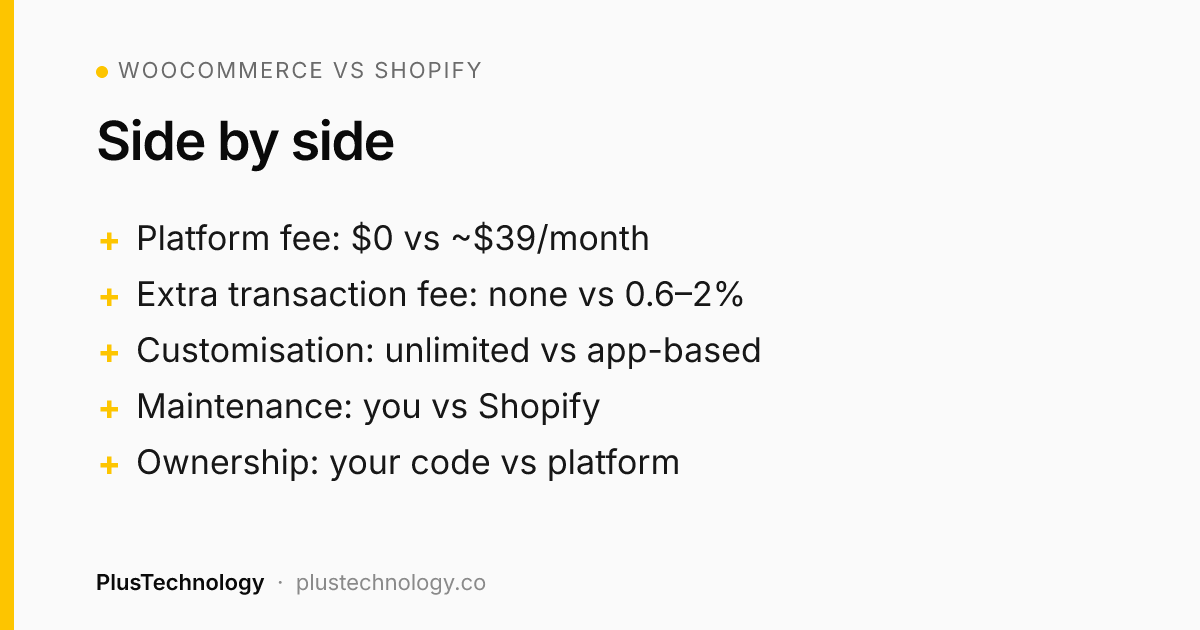
WooCommerce vs Shopify: side-by-side comparison
| WooCommerce | Shopify | |
|---|---|---|
| What it is | Free, open-source plugin for WordPress | Hosted, subscription e-commerce platform |
| Platform fee | $0 | Basic plan around $39/month (about $29/month billed yearly); higher tiers cost more |
| Hosting | You choose and pay for it (roughly $10–$50+/month for good managed hosting) | Included |
| Extra transaction fee | None from WooCommerce | Extra 0.6%–2% if you don't use Shopify Payments |
| Customisation | Unlimited: full code access | Good, within Shopify's rules and apps |
| SEO control | Full control of URLs, schema and content | Good, with fixed URL patterns (/products/, /collections/) |
| Maintenance | You (or your developer) handle updates and backups | Handled by Shopify |
| Ownership & lock-in | You own the code and data | Store lives on Shopify's platform |
| Best for | Content-led brands, complex products, WordPress users | Fast launches, dropshipping, owners who want zero tech work |
Shopify prices change; check Shopify's pricing page for current figures. Card processing fees (for example from Stripe, PayPal or Shopify Payments) apply on both platforms.
WooCommerce vs Shopify: real cost over 3 years
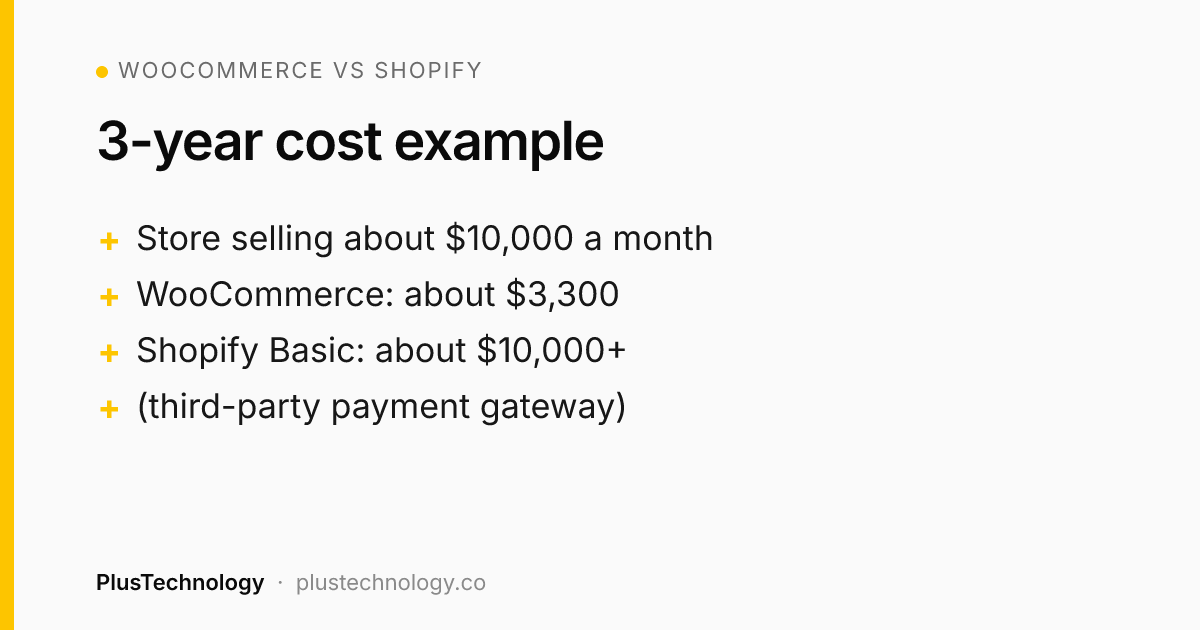
The monthly fee is only part of the cost. Here's an illustrative example for a small store selling about $10,000 a month, using a third-party payment processor on both platforms:
| Cost (3 years) | WooCommerce | Shopify (Basic) |
|---|---|---|
| Platform subscription | $0 | ~$1,050–$1,400 |
| Hosting | ~$900 (at $25/month) | Included |
| Premium extensions / apps | ~$600 (yearly licences) | ~$1,800 (at ~$50/month in apps) |
| Extra platform transaction fees | $0 | ~$7,200 (2% of $360,000) |
| Maintenance | ~$1,800 (care plan or developer time) | Minimal |
| Approximate total | ~$3,300 | ~$10,000+ |
If you use Shopify Payments, the extra transaction fee disappears and the gap narrows a lot. The build cost also matters: a custom WooCommerce store often costs more to set up than a Shopify theme. My point is to work out your own numbers, not to assume either platform is "cheap."
WooCommerce vs Shopify for customisation
This is where WooCommerce clearly leads. Because it runs on WordPress and you have full access to the code, you can build almost anything:
- Complex product configurators, custom pricing rules and B2B wholesale pricing
- Subscriptions, memberships, bookings and courses in one store
- Custom checkout fields and multi-step checkouts
- Direct integrations with your ERP, warehouse or CRM
Shopify can do a lot with apps, but each app adds a monthly fee, and some things (like heavily customised checkouts on lower plans) are restricted.
WooCommerce vs Shopify for SEO
Both platforms can rank well. The difference is control:
- WooCommerce inherits WordPress's strength as a content platform. You control URL structure, structured data, internal linking and blog content completely, using tools like Rank Math or Yoast.
- Shopify handles the basics well, but URLs always include
/products/or/collections/, and its blogging tools are more limited.
If content marketing (guides, comparisons, recipes, tutorials) is a big part of how you'll get customers, WooCommerce has the edge.
Maintenance and security
Shopify wins on convenience. Hosting, security patches, PCI compliance and uptime are Shopify's job.
With WooCommerce, you're responsible for updates, backups and security. That sounds scary but is manageable with good managed hosting, a short list of quality plugins, automatic backups and a monthly care plan. Most WooCommerce problems I fix come from cheap hosting and too many plugins, not from WooCommerce itself.
Scaling and performance
Shopify scales automatically, which is a real advantage for flash sales and sudden traffic spikes.
WooCommerce scales well too, but it depends on your setup. With proper hosting, object caching, High-Performance Order Storage (HPOS) and a lean theme, WooCommerce comfortably handles large catalogues and thousands of orders a day. On cheap shared hosting, it won't.
WooCommerce vs Shopify: which should you choose?
Choose Shopify if:
- You want to launch within days and never think about hosting or updates
- You sell simple products and don't need custom features
- You run a dropshipping or print-on-demand store that relies on Shopify apps
Choose WooCommerce if:
- You already have a WordPress website, or content is central to your marketing
- You sell products with complex options, B2B pricing, subscriptions or bookings
- You want to own your platform and avoid growing monthly app and transaction fees
- You need custom integrations with your other business systems
Frequently asked questions
Is WooCommerce cheaper than Shopify?
Usually over the long term, yes. WooCommerce itself is free and has no platform transaction fees, so ongoing costs are mainly hosting and a few premium extensions. Shopify has a monthly subscription, paid apps and an extra fee if you use a payment gateway other than Shopify Payments. WooCommerce can cost more up front if you pay a developer to build it.
Is WooCommerce or Shopify better for SEO?
Both can rank well. WooCommerce gives more control over URLs, structured data and content because it runs on WordPress, which makes it stronger for content-led SEO. Shopify is good out of the box but enforces some URL structures, such as /products/ and /collections/.
Can I move from Shopify to WooCommerce?
Yes. Products, customers and orders can be migrated with import tools or a custom script, and old Shopify URLs should be 301-redirected to the new WooCommerce URLs to protect search rankings.
Which is easier for beginners, WooCommerce or Shopify?
Shopify is easier for beginners because hosting, security and updates are handled for you. WooCommerce needs hosting and occasional maintenance, though a well-built store is simple to run day to day.
Planning a new store or a Shopify-to-WooCommerce migration? PlusTechnology builds and optimises WooCommerce stores for clients worldwide. Hire us on Upwork or get in touch.